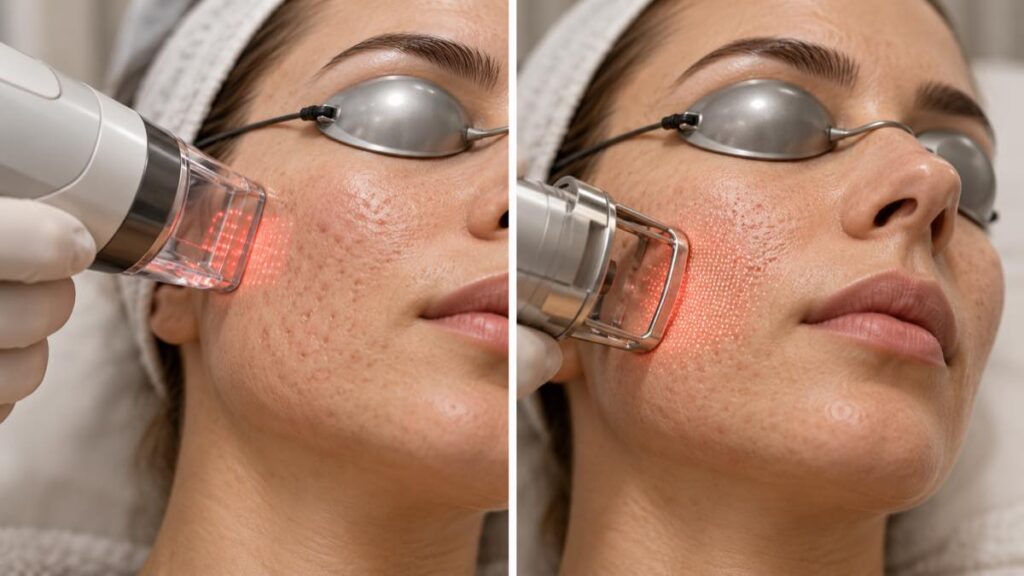
In short: A fractional CO2 laser is ablative. It removes tiny columns of skin, so it can improve deep acne scars more per session, but it usually brings about a week or more of redness and peeling and a higher risk of pigment changes in darker skin. Frax Pro is non-ablative. It heats tissue under an intact surface, so downtime is shorter and the pigment risk is generally lower, but most people need a course of sessions. The right choice depends on scar type, skin tone and how much downtime you can manage.
Key takeaways
- Both lasers are fractional, meaning they treat a grid of microscopic zones and leave healthy skin in between to speed healing.
- CO2 vaporises tissue (ablative). Frax Pro heats tissue without removing the surface (non-ablative).
- CO2 can do more per session for deep scars but has longer downtime and a higher risk of hyperpigmentation in skin types IV–VI.
- Frax Pro uses two wavelengths: Frax 1550 for deeper texture and scars, and Frax 1940 for surface tone and texture.
- Deep icepick or tethered scars often need combination treatment, such as subcision, RF microneedling or TCA CROSS, rather than any single laser.
How each laser works
Fractional CO2 (10,600 nm). This wavelength is absorbed by water in the skin. A fractional CO2 laser creates thousands of microscopic channels in which tissue is vaporised (ablated), surrounded by a zone of heat. The skin rebuilds those channels with new collagen. Because it removes tissue, it is the more aggressive option.
Candela Frax Pro (Frax 1550 and Frax 1940). Frax Pro is a non-ablative fractional platform. According to the manufacturer’s launch information, the Frax 1550 applicator reaches deeper, up to about 800 micrometres, to remodel collagen under scars, while the Frax 1940 applicator works more superficially, around 200 micrometres, on tone and fine texture. The skin surface stays largely intact. Roxana’s Frax Pro skin resurfacing page lists three to four sessions as common for acne scars.
Frax Pro vs CO2 at a glance
| Frax Pro (non-ablative fractional) | Fractional CO2 (ablative) | |
|---|---|---|
| How it works | Heats columns of tissue under an intact surface | Vaporises microscopic columns of skin |
| Typical sessions for acne scars | Several (Roxana’s page: 3–4 common) | Often fewer, depending on settings |
| Visible downtime | Redness and swelling for a few days, then flaking (Roxana’s page: peeling days 4–7) | Often about a week or more of redness, crusting and peeling; pinkness can last longer |
| Improvement per session | Moderate | Greater, especially at higher settings |
| PIH risk in skin types IV–VI | Lower, especially at conservative densities | Higher; needs careful settings and preparation |
| Pain and numbing | Topical numbing usually enough | Stronger numbing often needed |
| Best suited to | Rolling scars, texture, pores and tone; darker skin; people with limited downtime | Deeper scars in suitable skin types; people who can take time off |
What the evidence says
- Darker skin: an evidence review of non-ablative fractional lasers in skin of colour concluded they are safe and effective for acne scars and other conditions in Fitzpatrick IV–VI. The most important factor for PIH risk was treatment density, and the authors recommended conservative densities, longer intervals and more sessions rather than higher intensity. They noted that ablative fractional lasers can be more effective but carry longer recovery and higher complication risk in darker skin.
- Middle Eastern skin: a retrospective study from Saudi Arabia compared non-ablative fractional 1,550 nm and fractional CO2 for acne scars in ethnic skin. Both improved scars, and the non-ablative laser had less downtime. Transient hyperpigmentation was seen with both, and the authors proposed guidelines for safer settings.
- Broader guidance: a 2026 review of non-invasive treatments in Fitzpatrick IV–VI generally advises avoiding fully ablative lasers in darker skin types because of the risk of hyper- and hypopigmentation, and describes non-ablative fractional 1,540–1,550 nm resurfacing as effective and safe.
The evidence suggests CO2 isn’t “unsafe” for brown skin, but it needs very careful patient selection and settings. Non-ablative options have a wider safety margin.
Which is better for which scar?
| Scar or concern | Often considered | Why |
|---|---|---|
| Rolling scars (soft, wave-like dips) | Frax Pro, RF microneedling, subcision | Dermal remodelling; subcision releases tethering |
| Shallow boxcar scars | Frax Pro or CO2 | Both can soften edges; CO2 does more per session |
| Deep boxcar scars | CO2 in suitable skin, or combinations | Greater resurfacing needed |
| Icepick scars | TCA CROSS or punch techniques, plus laser | Narrow, deep scars respond poorly to lasers alone |
| Texture, pores and dullness | Frax Pro (1940 plus 1550) | Surface and mid-dermal renewal with less downtime |
| Post-acne marks (flat brown) | Not usually a resurfacing laser first | Pigment-focused treatment and sun protection |
Downtime in Dubai: plan around the sun
Both lasers make skin temporarily more sensitive to the sun, and darker skin is at risk of PIH if treated skin meets strong UV or heat too soon. In Dubai:
- Plan resurfacing when you can avoid beach days, desert trips and outdoor sport for a couple of weeks.
- Use daily broad-spectrum sunscreen (tinted is helpful) and a hat throughout the course.
- Stop retinoids and exfoliating acids before treatment as advised.
- Allow longer before major events with CO2 than with Frax Pro.
Safety and side effects
- Common to both: redness, swelling, warmth, flaking, temporary bronzing of the skin, and acne flares.
- More likely with CO2: crusting, oozing, prolonged redness, infection risk, cold-sore reactivation (antiviral cover is often used), hyperpigmentation, and rarely hypopigmentation or scarring.
- Frax Pro: mainly short-term redness, swelling and flaking. PIH is possible, especially at high densities.
Tell your clinician about any history of cold sores, keloid scarring, isotretinoin use, pigmentation problems or recent tanning.
How Roxana Aesthetics can help
Roxana Aesthetics Clinic on Al Wasl Road offers Candela Frax Pro resurfacing, with settings chosen for scar type, skin tone and downtime. For scars that need a combined approach, options may include Morpheus8 Pro RF microneedling, microneedling, chemical peels and dedicated scar removal treatment.
The bottom line
Frax Pro vs CO2 laser comes down to depth and downtime. CO2 can achieve more per session for deep scars but carries more downtime and pigment risk, especially in Middle Eastern and South Asian skin. Frax Pro builds results over a course with shorter recovery and a wider safety margin. Many scars respond best to a combined plan. Book a consultation with Roxana Aesthetics to have your scar types and skin tone assessed before choosing a laser.
Frequently asked questions
Is Frax Pro as good as CO2 for acne scars?
CO2 can achieve more improvement per session for deep scars because it removes tissue, but it has longer downtime and a higher pigmentation risk in darker skin. Frax Pro usually needs more sessions to reach a similar improvement, with less downtime. For many people, especially those with medium to dark skin, a course of non-ablative treatment is a safer route.
How much downtime does Frax Pro have?
Most people have redness and mild swelling for one to three days, followed by flaking or a rough, bronzed texture for a few more days. Many return to work quickly, using make-up once the skin allows. Roxana’s Frax Pro page describes peeling around days four to seven. Sun protection is essential throughout.
How much downtime does a CO2 laser have?
Fractional CO2 usually involves around a week or more of redness, swelling, crusting and peeling, depending on the settings. Pinkness can last several weeks. Higher settings mean more improvement per session and longer recovery. Your clinician will explain the expected downtime for your plan.
Is CO2 laser safe for brown skin?
Fractional CO2 can be used in some darker skin types, but the risk of hyperpigmentation, and less often lightening, is higher. It needs conservative settings, skin preparation and strict sun protection. Many clinicians prefer non-ablative lasers or RF microneedling for Fitzpatrick IV–VI skin to reduce that risk.
How many Frax Pro sessions will I need?
Roxana’s Frax Pro page notes that three to four sessions are common for acne scars, usually spaced several weeks apart, with more for deeper scars or stretch marks. Collagen remodelling continues for months, so full results are judged three to six months after the last session.
Can Frax Pro treat icepick scars?
Icepick scars are narrow and deep, and lasers alone often don’t improve them much. They usually respond better to targeted techniques such as TCA CROSS or punch methods, which can be combined with laser resurfacing for overall texture.
Can I combine Frax Pro with other treatments?
Yes. Acne scars often respond best to combinations, such as RF microneedling for rolling scars, subcision for tethered scars, and peels or skin boosters for tone and quality. Your clinician will plan the order and spacing so skin heals between treatments.
What affects the cost of laser resurfacing?
Cost depends on the device, the area treated, how many sessions you need and whether combination treatments are planned. A quote is best given after scar assessment, as plans vary considerably between individuals.
This article is general medical information, not a substitute for individual assessment. Laser suitability and risks depend on skin type, scar type and medical history.
Medically Reviewed by: Dr. Natallia Kaliashuk