Noticing more hair in the shower, a wider centre part or less volume around the temples can be unsettling. It can also send you down a long search for solutions. Two options you are likely to meet are platelet-rich plasma, or PRP, and hair mesotherapy. Both involve small injections into the scalp, but that is where much of the similarity ends.
So, when comparing PRP vs hair mesotherapy, which treatment makes more sense? For many people with early pattern-related thinning, PRP may be the stronger starting point because it uses concentrated platelets from the patient’s own blood and has a broader body of clinical research behind it. Hair mesotherapy can still be useful when a clinician wants to deliver selected ingredients directly into the scalp. The right choice, however, depends on why the hair is thinning, how advanced it is and what is being injected.
This guide explains the differences without promising a quick fix. Hair grows slowly, and a good treatment plan should begin with a proper assessment rather than a popular procedure.
First, what is causing your thinning hair?
Hair thinning is a description, not a diagnosis. Male or female pattern hair loss is common, but shedding can also follow illness, pregnancy, rapid weight change, emotional stress or nutritional deficiency. Thyroid problems, low iron, certain medicines and inflammatory scalp conditions may also play a part.
That distinction matters. An injectable treatment may support follicles that are still active, but it will not correct every underlying trigger. A careful consultation should consider the pattern and duration of hair loss, scalp health, medical history and any relevant tests. Sudden shedding, bald patches, pain, scaling or scarring warrants medical evaluation before cosmetic treatment.
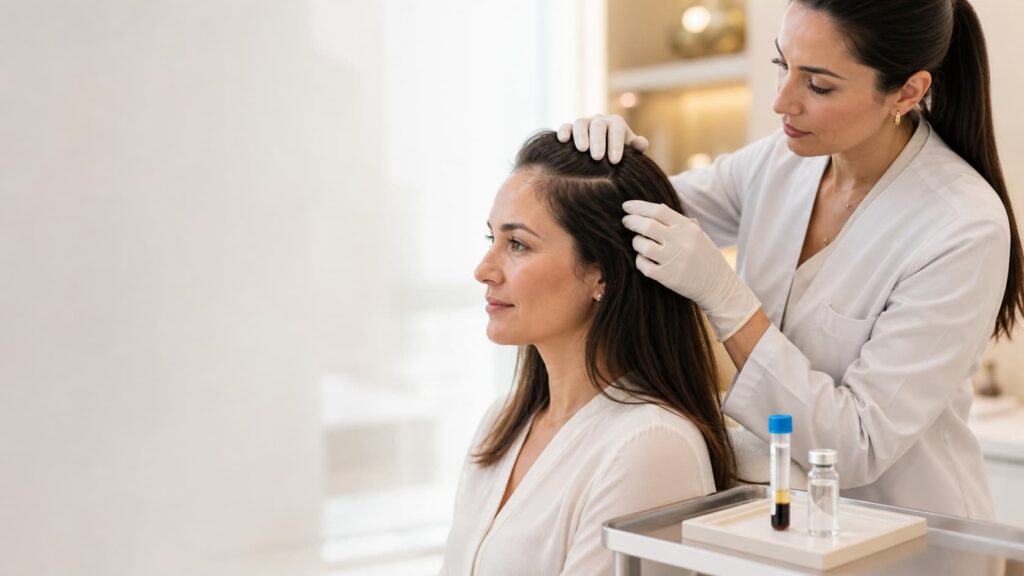
At Roxana Aesthetics Clinic, the first step in a personalised hair loss treatment in Dubai is a scalp assessment. This helps the practitioner decide whether PRP, mesotherapy or another approach fits the concern.
What is PRP hair treatment?
A PRP hair treatment begins with a small blood draw. The sample is spun in a centrifuge to separate and concentrate the platelets in plasma. The prepared platelet-rich plasma is then injected into selected areas of the scalp.
Platelets release signalling proteins, often called growth factors, that are involved in tissue repair. When PRP is used for pattern hair loss, the aim is to support the follicle environment, encourage follicles to remain in the active growth phase and improve hair density over time. Because the material comes from your own blood, PRP does not use an off-the-shelf vitamin cocktail.
Research is encouraging, although it is not perfectly uniform. A systematic review and meta-analysis of nine randomised trials found that PRP increased hair density at three and six months compared with placebo. The authors also noted differences in preparation and treatment protocols between studies. That means outcomes can vary, and PRP should not be presented as guaranteed regrowth.
Potential advantages of PRP
- It uses an autologous, or patient-derived, preparation.
- It has more published clinical evidence for androgenetic alopecia than many injectable scalp cocktails.
- It may help improve density and reduce visible thinning when viable follicles remain.
- Treatment is non-surgical, with limited interruption to most daily routines.
The trade-off is that PRP involves a blood draw as well as scalp injections. Temporary tenderness, redness, swelling or pinpoint bleeding may occur. A course of sessions is commonly recommended, followed by progress reviews and possible maintenance, but the schedule should be tailored rather than copied from a standard package.
What is hair mesotherapy?
Hair mesotherapy describes a delivery technique: small quantities of selected substances are placed into the scalp through superficial micro-injections. Depending on the treatment plan, a formulation may contain vitamins, minerals, amino acids, peptides, hyaluronic acid, growth-supporting ingredients or certain medicines. The precise formula matters, so “mesotherapy” is not one universally standardised product.
The aim is to place chosen ingredients close to the treatment area rather than relying only on a topical application. Roxana’s mesotherapy treatment in Dubai is personalised after an assessment of the scalp, hair concern, medical history and goals.
Potential advantages of mesotherapy
- The formulation can be selected for the individual’s scalp and hair needs.
- It does not require a blood draw.
- It can be considered for mild to moderate thinning or ongoing shedding when clinically appropriate.
- Sessions are generally brief and involve little downtime.
Mesotherapy also has limitations. Published studies use different ingredients, concentrations, injection depths and schedules, making results difficult to compare. A systematic review of mesotherapy for hair loss found reports of improved hair growth but concluded that regimens are not standardised and larger controlled trials are needed. Safety and suitability depend on the substance used, the patient’s medical history and the skill of the practitioner.
PRP vs hair mesotherapy: the practical differences
| Point of comparison | PRP | Hair mesotherapy |
|---|---|---|
| What is injected? | Concentrated platelet-rich plasma prepared from your blood | A selected formulation of active ingredients |
| Blood draw required? | Yes | No |
| Main rationale | Uses platelet signalling factors to support the follicle environment | Delivers chosen ingredients directly into the scalp |
| Evidence for pattern hair loss | More substantial, although protocols still vary | Promising but less standardised and formulation-dependent |
| Typical experience | Blood draw, preparation and scalp injections | Superficial scalp micro-injections |
| Downtime | Usually limited; tenderness or redness can occur | Usually limited; tenderness, redness or swelling can occur |
| Best suited to | Often considered for early to moderate pattern thinning with active follicles | May suit selected cases where targeted scalp delivery is appropriate |
Which is the better treatment for thinning hair?
If “better” means the option with the clearer overall research base for pattern hair loss, PRP generally has the advantage. It may be especially relevant for men and women with early to moderate androgenetic alopecia who still have functioning follicles and are comfortable having blood taken.
Mesotherapy may be worth considering when a practitioner identifies a reason to use a specific injectable formulation, or when someone prefers a treatment that does not involve a blood draw. It should not be chosen simply because it is described as a nutrient boost. Ask exactly what the formulation contains, why those ingredients suit your diagnosis and what evidence supports the proposed protocol.
In some cases, the best treatment for thinning hair is not a choice between these two at all. A clinician may recommend addressing a deficiency, treating a scalp disorder or discussing established medical therapies. PRP or mesotherapy may form one part of a broader plan. Combining treatments is not automatically better; each element should have a clear purpose.
What results can you realistically expect?
Neither option creates instant volume. Hair cycles unfold over months, so early changes may be a reduction in shedding or small new hairs before a visible improvement in density. Progress photographs taken under consistent lighting can be more useful than checking the mirror every day.
Results vary with the diagnosis, age, follicle health, extent of loss and adherence to the recommended plan. Maintenance may be suggested because pattern hair loss is progressive. Where follicles are no longer active, injectable treatments are unlikely to recreate them, and a different approach may be needed.
It is also sensible to plan around the short-term effects of injections. The scalp can feel tender, tight or mildly swollen, and there may be small areas of redness. Follow the clinic’s aftercare advice and report any unexpected or persistent symptoms.
Questions to ask at your consultation
Before booking PRP or hair mesotherapy in Dubai, ask:
- What is the likely cause of my thinning, and do I need further tests?
- Are the follicles in the affected area still active?
- What exactly will be injected, and why is it appropriate for me?
- How many sessions are proposed, and when will progress be reviewed?
- What side effects, contraindications and aftercare should I know about?
- What result is realistic in my case, and will maintenance be needed?
Clear answers are more valuable than dramatic promises. They also make it easier to compare the real cost and commitment of each option.
The bottom line
In the debate over PRP vs hair mesotherapy, PRP is often the more evidence-supported choice for early pattern-related thinning. Hair mesotherapy remains a flexible option, but its value depends heavily on the ingredients used and the reason they have been selected. Neither should be recommended before the cause and stage of hair loss are understood.
Roxana Aesthetics Clinic offers personalised hair and scalp assessments at its Al Safa clinic. Explore the clinic’s hair loss treatment options or learn more about mesotherapy for the hair and skin, then book a consultation to discuss a plan shaped around your needs.
This article is for general information and does not replace individual medical advice. Treatment suitability and results vary.