In short: No single treatment works for every acne scar. Soft, rolling scars often respond well to RF microneedling such as Morpheus8. Shallow boxcar scars and rough texture often suit fractional laser such as Frax Pro. Deep, narrow icepick scars usually need a targeted method first. Most people have more than one scar type, so the best results usually come from a planned combination over several months.
Key takeaways
- Start with the scar type, not the device. Rolling, boxcar and icepick scars sit at different depths and respond to different treatments.
- Flat red or brown marks after acne are not true scars. They are pigment or redness, and they need a different approach.
- Morpheus8 and Frax Pro both rebuild collagen, but in different ways. Many plans use both.
- Darker skin tones can be treated safely, but settings need care to avoid post-inflammatory hyperpigmentation (PIH).
- Expect a course of sessions and gradual change over 3–6 months, not a one-visit result.
First, check if it is a scar or a mark
Many people book “acne scar treatment” for marks that are not scars at all.
- Post-acne marks (PIH): flat brown or dark patches. The skin surface is smooth. They often fade with time, sun protection and pigment-focused treatment.
- Post-acne redness (PIE): flat pink or red patches, common in lighter skin. Again, the surface is smooth.
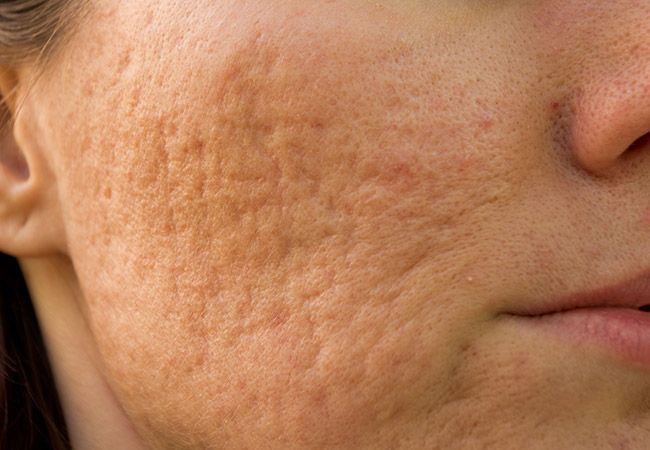
- Acne scars: a change in the skin’s surface. You can see a dip or a raised area, especially in side lighting.
A simple check is to stretch the skin gently. If the dip softens, it is likely a rolling scar. If it stays sharp, it is likely boxcar or icepick. A flat mark that only changes colour is likely PIH or PIE.
If your concern is mostly flat marks, read Sun Damage, Melasma or Post-Acne Marks? instead.
The main types of acne scars
Rolling scars
Wide, soft dips with gently sloping edges. They give the skin a wavy look. Bands of tissue under the skin pull the surface down. They become more visible with age as the skin loses collagen.
Boxcar scars
Round or oval dips with sharp, steep edges, a bit like a chickenpox scar. They can be shallow or deep.
Icepick scars
Narrow, deep holes, usually less than 2 mm wide. They look like large, open pores. They are the hardest type to treat, because they reach deep into the skin.
Raised scars (hypertrophic and keloid)
Firm, raised scars, more common on the jawline, chest, back and shoulders. They need a different treatment plan and are not covered by resurfacing alone.
Which treatment for which scar?
| Scar type | Often considered | Why |
|---|---|---|
| Rolling scars | Morpheus8 (RF microneedling), subcision, Frax Pro | Rebuilds collagen under the dip. Subcision releases the bands that pull the skin down. |
| Shallow boxcar scars | Frax Pro, Morpheus8, chemical peels | Softens the sharp edges and smooths texture. |
| Deep boxcar scars | Combination plans: Frax Pro or Morpheus8 plus a targeted method | Deep, steep edges rarely respond to one treatment alone. |
| Icepick scars | TCA CROSS or punch techniques first, then resurfacing | Narrow and deep, so surface treatments alone have little effect. |
| Mixed scars (most people) | A staged plan, often Morpheus8 and Frax Pro across a course | Each scar type in the same area gets the method it needs. |
| Raised scars | Assessed separately by a doctor | They need treatment that flattens tissue, not resurfacing. |
| Flat brown or red marks | Pigment or redness treatment, plus sun protection | These are not scars, so resurfacing is not the first step. |
Morpheus8 vs Frax Pro for acne scars
Both treatments use controlled injury to make the skin produce new collagen. The difference is how they reach the scar.
Morpheus8 Pro uses fine needles that deliver radiofrequency heat deep under the skin surface. It works well on rolling scars and on scars with some skin laxity around them. The surface is only lightly affected, which makes it a common choice for darker skin tones.
Frax Pro is a non-ablative fractional laser. It heats tiny columns of skin while leaving the surface intact. The 1550 applicator works deeper on scars and texture. The 1940 applicator works closer to the surface on tone and fine texture. It suits shallow boxcar scars, rough texture and enlarged pores.
| Morpheus8 Pro | Frax Pro | |
|---|---|---|
| How it works | Microneedles plus radiofrequency heat | Non-ablative fractional laser |
| Best suited to | Rolling scars, scars with laxity, darker skin | Shallow boxcar scars, texture, pores, tone |
| Typical course | Usually a course of about 3 sessions, 4–6 weeks apart | 3–4 sessions are common for acne scars |
| Visible downtime | Redness and small marks for a few days | Redness and swelling for 1–3 days, then flaking around days 4–7 |
| Numbing | Numbing cream for about 30 minutes | Numbing cream |
For a closer look at lasers, including fractional CO2, read Frax Pro vs CO2 Laser for Acne Scars.
Where chemical peels fit
Chemical peels help with surface texture and post-acne marks. They can soften very shallow scars over a course. They do not reach deep enough to lift rolling, deep boxcar or icepick scars on their own. In a scar plan, they usually come before or between device sessions to even out tone.
Acne scars in darker skin tones
Many people in Dubai have Middle Eastern, South Asian or African skin (Fitzpatrick types III–VI). This skin heals well, but it reacts to heat and inflammation by making more pigment. Aggressive settings can leave dark patches (PIH) that last for months.
Safer plans for darker skin often use:
- RF microneedling or non-ablative laser rather than fully ablative laser
- Lower densities with more sessions, rather than high settings with fewer sessions
- Skin preparation for a few weeks before treatment, if the doctor advises it
- Strict sun protection before and after each session
Read more in Pigmentation in Middle Eastern and South Asian Skin.
Sessions, downtime and risks
Sessions. Most acne scar plans need 3–6 sessions in total, often 4–6 weeks apart. Deep or mixed scars may need more.
Results timeline. Skin can look smoother within a few weeks. Collagen keeps building for 3–6 months after the last session. Scars usually improve a lot but rarely disappear completely.
Downtime. Plan for a few days of redness and swelling after each session. With Frax Pro, expect some flaking around days 4–7.
Possible side effects. Redness, swelling, flaking, small marks, acne flares and temporary darkening of the skin. Less often: infection, cold-sore flare-ups and longer-lasting pigment changes.
Tell your doctor if you:
- Have taken isotretinoin (Roaccutane) in the last 6–12 months
- Get cold sores
- Form raised or keloid scars easily
- Have active acne, a skin infection, or are pregnant
- Have a recent tan
Planning treatment around Dubai’s sun
Treated skin is more sensitive to sun and heat for a few weeks. In Dubai:
- Plan your course when you can avoid the beach, desert trips and long outdoor sport for about two weeks after each session.
- Use a broad-spectrum sunscreen every day, and reapply it outdoors. A tinted one gives extra protection against visible light.
- Stop retinoids and exfoliating acids before treatment, as your doctor advises.
- Leave enough time before weddings or events. Two weeks is a sensible minimum after a resurfacing session.
What affects the cost of acne scar treatment in Dubai
There is no fixed price for acne scar treatment, because every plan is different. The main factors are:
- The scar types you have and how deep they are
- How large the treatment area is (cheeks only, full face, or back)
- Which treatments are combined
- How many sessions you need
A consultation gives you a written plan with the number of sessions, so you know the full cost before you start.
What happens at an acne-scar assessment
At Roxana Aesthetics Clinic, the assessment starts with a doctor examining your skin in good light, often from several angles. They check:
- Which scar types you have, and in which areas
- Whether there is still active acne, which should be controlled first
- Your skin tone and how your skin has healed in the past
- How much downtime you can manage
You then get a staged plan with the treatments, the number of sessions and the expected timeline.
Book a personalised acne-scar assessment with a doctor at Roxana Aesthetics Clinic, 825 Al Wasl Road, Dubai. You can also message the clinic on WhatsApp at +971 54 581 3345.
Frequently asked questions
What is the best treatment for acne scars in Dubai?
It depends on the scar type. Rolling scars often respond to Morpheus8. Shallow boxcar scars often suit Frax Pro. Icepick scars usually need a targeted method first. Most people get the best results from a combination planned by a doctor.
Is Morpheus8 or Frax Pro better for acne scars?
Neither is better for everyone. Morpheus8 works deeper under the skin and suits rolling scars and darker skin. Frax Pro works well on shallow boxcar scars, texture and pores. Many plans use both across a course.
How many sessions do acne scars need?
Most plans need 3–6 sessions, about 4–6 weeks apart. Deep or mixed scars may need more. Your doctor will give you an estimate after the assessment.
Can acne scars be removed completely?
Scars usually improve a lot, but complete removal is rare. A realistic goal is smoother skin and scars that are much less visible in normal light.
Is acne scar treatment safe for brown skin?
Yes, with the right method and settings. RF microneedling and non-ablative lasers at careful settings carry less risk of dark patches than aggressive ablative lasers. Sun protection before and after treatment matters a lot.
Can I treat acne scars while I still have active acne?
Active acne is usually treated first. New breakouts can create new scars, and some treatments can make active acne flare.
How long is the downtime?
Usually a few days of redness and swelling after each session. With Frax Pro, flaking often follows around days 4–7. Most people go back to work within a day or two.
Do chemical peels work for acne scars?
Peels help with surface texture and dark marks after acne. They can soften very shallow scars. Deeper scars usually need RF microneedling or fractional laser.
What affects the cost of acne scar treatment?
The scar types, the size of the area, the treatments combined and the number of sessions. A consultation gives you a full plan before you commit.
This article is for general information. It is not medical advice. Results vary from person to person. Speak to a qualified doctor about your own skin before starting any treatment.